



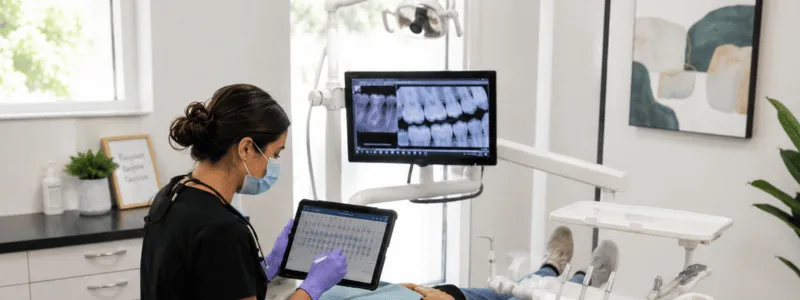
Periodontal charting is one of the most important things you do at every appointment, and one of the easiest to rush, shortcut, or put off when the schedule gets tight. Nearly 42% of American adults 30 and older have some form of periodontitis, which means you’re probing active disease in almost half your adult appointments, whether it looks like it or not.
The chart is your record, your diagnosis tool, and your legal protection, all in one. These periodontal charting tips will help you work faster, document more accurately, and have better conversations with both your patients and dentist.
A quick answer on best practices: Comprehensive perio charting means recording six probing depths per tooth across 28 teeth, plus bleeding on probing, recession, furcation classification, and mobility at a minimum once per year for every adult patient. PSR is a screening tool, not a substitute for full charting.
Charting Less Than Six Points Per Tooth Costs You Later
Six-point probing isn’t optional. Mesial, mid-buccal, distal, mesial-lingual, mid-lingual, distal-lingual – all 168 sites matter. Skipping points, estimating depths, or recording only the worst site per tooth creates an incomplete picture of what is actually happening in the mouth.
From a legal standpoint, an incomplete chart is difficult to defend. If a patient later develops significant attachment loss and the records show gaps, the documentation works against you and your practice. The standard of care, as recognized by dental experts and widely cited in negligence cases, is full-mouth six-point probing with every number recorded, at least annually for adult patients.
If the barrier is time, the fix is not fewer data points. It’s a better workflow.
A Recording Assistant Changes Everything
The single biggest bottleneck in perio charting is having to stop probing to type or write. Every time you pull your probe out of the sulcus to hit a key, you lose your place, your rhythm, and time you cannot get back.
Having a recording assistant isn’t a luxury, it’s a clinical efficiency standard. When a trained assistant or front desk staff member enters numbers as you call them out, you move through a full-mouth chart in a fraction of the time. If you are in an office where you routinely chart solo, this is worth raising with your dentist or office manager as a protocol conversation, not just a personal preference.
In offices without consistent assistant support, voice-activated charting software is a realistic alternative. Tools that allow you to call out numbers and have them populate automatically remove the manual recording step entirely and keep your focus on probing.
Digital Charting Beats Paper Every Time
If your office is still on paper charting, you already know the friction. Manual entry, difficult legibility, no automatic calculation of clinical attachment level, and no easy year-over-year comparison.
Digital charting software changes the workflow in ways that matter: CAL calculates automatically as you enter probing depths and recession values. Furcation, mobility, bleeding, and suppuration can be flagged with a click. Year-over-year comparisons are visual and immediate, which makes patient education far more concrete. You can show a patient the chart from their last appointment alongside today’s and point to exactly where things changed.
If your practice hasn’t moved to digital yet, this is a conversation worth having. The data is easier to use, easier to defend, and significantly faster to record once the team is trained on the software.
Record Bleeding Points, Not Just Pocket Depths
Probing depths tell you where the pockets are, but bleeding on probing tells you where active inflammation is happening right now.
Bleeding points are not just a note, they’re a clinical finding that maps bacteria access to the circulatory system. When you total pocket depths by category (1-3 mm, 4 mm, 5-7 mm, 8+ mm) alongside bleeding point count, the picture becomes a real case presentation. What sounds like “just some fours and a little bleeding” may actually be 23 pockets with 20 bleeding points, and that is a very different conversation with the patient and the dentist.
Chart everything, total everything, and then use the numbers to tell the patient what is actually going on.
Record Bleeding Points, Not Just Pocket Depths
Full-mouth perio charting plus a full-mouth series of radiographs in a 45-minute recare slot is a setup for rushing, cutting corners, or burning yourself out by 2 p.m. For existing recare patients, alternating perio charting with radiograph appointments is a reasonable protocol that gives each task proper time.
For new patient comprehensive exams, both the radiographs and full periodontal assessment should be completed before treatment, since accurate classification depends on having the full picture. These appointments typically have longer time allowances precisely for this reason.
If your schedule doesn’t allow adequate time for proper charting, that is an operational issue not a clinical trade-off you should absorb by doing less.
Perio charting is the foundation of everything else you do at the chair. When the chart is complete and accurate, you can diagnose with confidence, present treatment with data behind you, and document care that holds up legally and clinically.
If you’re working in an office where the schedule, staffing, or tools make it hard to do the job right, that friction is real. GoTu connects dental hygienists with offices that value clinical standards and respect the time it takes to do thorough work. If you are ready for a change, find flexible shifts near you and see what is available in your area.