



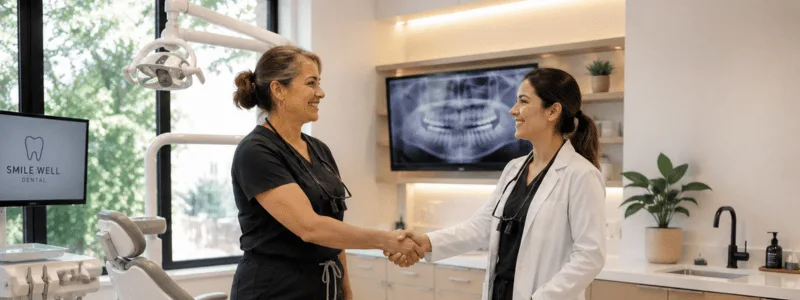
Most dental hygienist interviews follow a pattern once you know what to look for. This guide breaks down the questions candidates get asked most often and how to answer them with confidence, then flips the script for offices building a smarter interview process.
Dental hygienist interviews typically cover clinical judgment, patient communication, and how a candidate handles a busy schedule. The strongest answers use specific examples rather than general or generic statement. Offices get the most out of an interview by asking scenario-based questions instead of yes or no ones.
The Hygiene Questions You’ll Actually Get Asked
Interviewers rarely ask “are you a good hygienist.” They ask questions designed to reveal how you think under pressure. Expect questions on why you chose hygiene, how you explain a treatment plan to a nervous patient, and how you’ve handled a scheduling conflict or a difficult coworker.
You’ll almost always get some version of “walk me through your process for a routine cleaning.” This isn’t a test of textbook knowledge, it’s a check on whether your workflow matches how the office actually runs, so answer with real steps, not a memorized script.
Questions about infection control and sterilization protocols show up often. Interviewers want to hear that you take it seriously without turning your answer into a lecture. One or two sentences on your standard protocol, tied to a specific certification or training, typically lands better than a long explanation.
Answering Why Did You Leave Your Last Position
The hardest questions are usually clinical judgment calls with no perfect answer. “A patient refuses X-rays, how do you handle it.” “You notice something concerning during a cleaning that isn’t on the chart, what do you do.” These questions test whether you know when to make a call yourself and when to loop in the dentist.
The best preparation is thinking through two or three real situations from your own experience before the interview, not rehearsing hypothetical answers. Specific stories are more convincing than general philosophies, and they’re easier to remember under pressure.
Preparing for the Clinical Scenario Questions
The hardest questions are usually clinical judgment calls with no perfect answer. “A patient refuses X-rays, how do you handle it.” “You notice something concerning during a cleaning that isn’t on the chart, what do you do.” These questions test whether you know when to make a call yourself and when to loop in the dentist.
The best preparation is thinking through two or three real situations from your own experience before the interview, not rehearsing hypothetical answers. Specific stories are more convincing than general philosophies, and they’re easier to remember under pressure.
What to Ask When It’s Your Time to Ask Questions
Candidates get evaluated on their questions too. Asking about patient volume, average appointment length, and how the office handles emergencies signals that you think operationally, not just clinically. Asking about turnover or why the position is open is fair game and tells you a lot about what you’re walking into.
Skip questions you could have answered by reading the website. Save those for research before the interview so your questions asked in the interview show genuine curiosity about the role.
What Offices Should Actually Be Asking During Interviews
Asking generic interview questions gets you generic answers. “Tell me about your strengths” produces a rehearsed response almost every time, while scenario-based questions produce a real one. Ask how a candidate would handle a patient who’s anxious about a procedure, or what they’d do if they fell behind schedule by two patients before lunch.
Pay attention to how a candidate talks about past patients and past coworkers; respectful, specific language is a strong signal. Vague or dismissive language, even about a difficult situation, often predicts how they’ll talk about your team later.
Ask about their comfort level with your specific equipment and software before assuming familiarity. A hygienist who’s confident and experienced can still need a short ramp-up period on a system they haven’t used, and knowing that upfront prevents a rocky first week.
Red Flags Worth Noticing for Hygienists and Offices
Candidates should notice if an office can’t clearly explain the schedule, the patient load, or why the position is open. Vague answers to direct questions in an interview tend to predict vague communication once you’re on staff.
Offices should notice if a candidate can’t walk through their actual clinical process when asked, or if every answer is a generality instead of a specific example. Confidence without specifics is harder to evaluate and often means less experience than the resume suggests.
Whether you’re prepping for your next interview or building a better process to run one, the goal on both sides is the same: less guessing, more fit. If you’re a hygienist ready to skip the long interview cycle for flexible, verified shift work, you can browse open hygienist shifts and start choosing your own schedule. If you’re an office trying to fill a gap faster than a traditional hiring process allows, you can post a shift and get matched with verified candidates.