


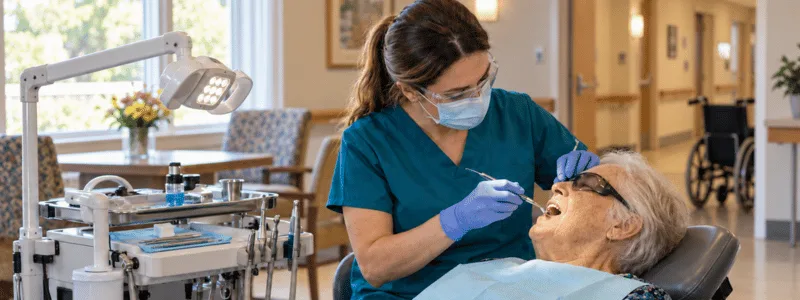
Forty-three states now let dental hygienists treat at least some patients without a dentist in the room, up from 28 in 2008, according to the American Dental Hygienists’ Association (ADHA). The catch is in the fine print. Most of those states limit where you can practice, who you can treat, and what paperwork you need before you start.
Hygienists want that freedom. In GoTu’s 2026 State of Work Report, 46.6% of hygienist respondents said more autonomy would improve their profession.
This guide breaks down which states let hygienists work without a dentist in 2026, which laws changed this year, and what it actually takes to qualify.
Can dental hygienists work without a dentist? Yes, in most states. As of 2026, 43 states allow some form of direct access, meaning a hygienist can assess and treat patients without a dentist present or authorizing care first. Colorado and Maine come closest to fully independent practice. Most other states require a collaborative agreement, a special permit, or a public health setting.
Direct Access Means More Than “No Dentist in the Room”
ADHA defines direct access as three things together. You can start treatment based on your own assessment, treat the patient without a dentist present, and keep an ongoing provider-patient relationship. A state can check one box without checking all three.
That’s why supervision levels matter. Under direct supervision, the dentist is on site. Under indirect supervision, the dentist authorizes the work and stays in the building. Under general supervision, the dentist authorizes the work but doesn’t need to be there. Collaborative practice lets you work under a written agreement instead of day-to-day oversight, and true direct access lets you decide what care the patient needs.
Here’s the part most state maps skip. In a traditional private dental office, nearly every state still requires some level of dentist supervision. Direct access mostly applies outside the office: schools, nursing homes, hospitals, community clinics, mobile programs, and patients’ homes.
Hygienists Are Asking for More Autonomy
Autonomy isn’t a niche ask. In GoTu’s 2026 State of Work Report, developed with ADHA, 3,853 hygienist respondents named the changes that would most improve their profession. More autonomy came in at 46.6%, alongside better benefits (71.6%), better pay (66.1%), license portability (56.1%), and more respect (50.9%).
It’s a retention issue, too. Across all 7,914 respondents, 62% said greater clinical decision-making authority would make them more likely to stay in the profession. Hygienists already trail the wider workforce on staying power: 77.7% of hygienist respondents plan to stay 10 or more years, compared with 82.8% of all respondents.
That’s why scope-of-practice law matters so much. Asks like autonomy and license portability can’t be won in a one-on-one negotiation with your office. They change at the state level.
Colorado and Maine Come Closest to True Independent Practice
If the goal is your own hygiene business with no dentist signing off, two states stand apart.
Colorado has allowed unsupervised hygiene practice since 1987. Per the ADHA direct access chart, no dentist needs to authorize or supervise most hygiene services, there are no extra hour requirements, and hygienists can own a practice outright. You can provide hygiene diagnosis, radiographs, scaling, fluoride and other preventive agents, and charting on your own. Local anesthesia is the main exception and still requires general supervision.
Maine licenses Independent Practice Dental Hygienists (IPDHs). After 2,000 hours of verified clinical practice, an IPDH can practice without a dentist’s supervision, authorization, or on-site presence. One string remains: taking radiographs requires a written agreement with a dentist who reviews the images within 21 days. Maine’s scope got wider in 2026, too (more on that below).
Collaborative Practice States Offer Real Autonomy
The next tier lets you practice without a dentist on site, as long as you have a written agreement or special license. These are the states where hygienists build mobile practices, contract with facilities, and in some cases own the business.
California offers the Registered Dental Hygienist in Alternative Practice (RDHAP) license. You need 2,000 clinical hours in the past 36 months, a bachelor’s degree or 120 semester units, a 150-hour RDHAP program, and a written exam. RDHAPs can work as sole proprietors in homes, schools, residential facilities, hospitals, and dental shortage areas. After 18 months, you need written verification that the patient has seen a dentist or physician.
New Mexico lets collaborative practice hygienists work in any setting and own or manage their own practice. You need 2,400 hours in the past 18 months, or 3,000 hours in two of the past three years, plus a written agreement with a collaborating dentist.
Indiana uses an access practice agreement. With 2,000 supervised clinical hours over two years, an NPI number, and liability insurance, you can provide preventive care in any setting your agreement lists.
Arizona has affiliated practice for hygienists with five years of licensure (three with a bachelor’s) and 500 practice hours in each of the past two years, plus 12 hours of specified CE. Minnesota collaborative practice hygienists can work in hospitals, nursing homes, schools, and nonprofit clinics, and can give local anesthesia and nitrous oxide. Alaska offers a collaborative agreement after 4,000 hours, plus an advanced practice permit for homebound, school, and shortage-area patients.
Oregon licenses Expanded Practice Dental Hygienists (EPDHs) and requires insurers to reimburse them. Washington allows hygienists with 2 years of experience to work unsupervised in hospitals, nursing homes, and public health facilities. Wisconsin drops the dentist authorization and presence requirement entirely in settings outside a dental office, with no added hour requirement.
Most States Limit Autonomy to Public Health Settings
The biggest group of states lets hygienists work without a dentist only in specific community settings or for specific patients. Think schools, Head Start programs, nursing homes, FQHCs, correctional facilities, and homebound patients. These rules exist to close access gaps, so the setting is usually the whole point.
Florida lets hygienists work without a dentist present in “health access settings” like school programs, Head Start centers, and nonprofit community health centers. A dentist must see the patient within 13 months of a cleaning. Texas allows up to six months of care in schools, nursing facilities, and community health centers before the patient needs a dental exam.
Pennsylvania certifies Public Health Dental Hygiene Practitioners after 3,600 hours. Illinois public health hygienists need 4,000 hours plus 42 hours of public health coursework, and can only treat Medicaid-eligible or uninsured patients at or below 200% of the federal poverty level. Missouri is notable because its public health hygienists can bill Medicaid directly for children’s care.
Kansas runs a three-tier Extended Care Permit system. The top tier, ECP III, requires 2,000 hours plus an 18-hour course and adds services like interim restorations and denture adjustments. Virginia calls its version remote supervision and requires 2,500 hours plus a dedicated CE course. Ohio issues an Oral Health Access Supervision Permit after 1,500 hours and 24 CE credits.
The pattern repeats across Connecticut, Georgia, Iowa, Kentucky, Massachusetts, Michigan, Montana, Nebraska, Nevada, New Hampshire, Oklahoma, Rhode Island, South Carolina, South Dakota, Tennessee, Utah, Vermont, West Virginia, and Wyoming, each with its own hours, settings, and patient limits. Idaho, Maryland, and North Carolina also make ADHA’s list, but their pathways keep a dentist closely involved through authorization or standing orders.
Seven States Still Require a Dentist for Hygiene Care
Alabama, Delaware, Hawaii, Louisiana, Mississippi, New Jersey, and North Dakota don’t appear on ADHA’s February 2025 direct access chart. In these states, dentist authorization and supervision remain the rule for hygiene care. Washington, D.C. isn’t on the chart either.
You may see North Carolina on older “no direct access” lists. ADHA now includes it because of its Dental Hygiene Limited Supervision Statute, which lets experienced hygienists work in nursing homes, schools, and rural clinics under a dentist’s written standing order. It’s a narrow pathway, but it counts.
What Changed for Hygienists in 2026
Scope-of-practice bills moved fast this year. Here’s what actually changed for hygienists, and what didn’t.
Utah expanded into hospitals. Gov. Spencer Cox signed House Bill 414, which adds hospitals to the public health settings where hygienists can practice without general supervision. It took effect May 6, 2026, and joins existing settings like schools, nursing homes, FQHCs, and mobile programs.
Maine widened its independent scope. The legislature enacted LD 2030 in March 2026. Independent Practice Dental Hygienists can now give local anesthesia and nitrous oxide, as long as they hold the right licensure authority. That makes full periodontal therapy possible without a dentist in the chain.
New York signed a big one, but you can’t use it yet. Gov. Kathy Hochul signed S3157/A2341 in December 2025. It lets hygienists approved as RDH-CP (collaborative practice) treat patients in hospitals, FQHCs, long-term care facilities, and other authorized settings without on-site supervision. You’ll need three years and 4,500 hours of practice plus an 8-hour CE program. Per Nixon Peabody’s summary, the law doesn’t take effect until June 19, 2027.
Connecticut came close. House Bill 5140 would have let hygienists with two years of experience treat patients in their homes without a dentist’s general supervision. It passed the House unanimously but never got a final Senate vote before the session ended in May. Lawmakers return in January 2027.
Idaho stalled. House Bill 805 would have let hygienists perform any service within their education and training. It was referred to committee in March and didn’t advance.
More is coming. ADHA’s 2026 to 2028 strategic plan puts professional autonomy front and center, so expect another wave of bills next session.
Every State’s Direct Access Rules at a Glance
Use this as a starting point, then confirm the details with your state dental board before you change how you practice.
| State | Direct access? | Pathway and key requirements |
|---|---|---|
| Alabama | No | Dentist supervision required |
| Alaska | Yes | Collaborative agreement (4,000 hrs) or Advanced Practice Permit for homebound, school, and shortage-area patients |
| Arizona | Yes | Affiliated practice agreement; 5 yrs licensed (3 with a bachelor’s), 500 hrs in each of the past 2 yrs, 12 hrs CE |
| Arkansas | Yes | Collaborative Care Permit I (1,200 hrs) or II (1,800 hrs) for children, seniors, and people with disabilities in public settings |
| California | Yes | RDHAP license (2,000 hrs, bachelor’s or equivalent, 150-hr program, exam); can be a sole proprietor |
| Colorado | Yes | Unsupervised practice with no added requirements; can own a practice |
| Connecticut | Yes | Public health hygienist with 2 yrs experience in institutions, public health facilities, group homes, schools |
| Delaware | No | Dentist supervision required |
| Florida | Yes | Health access settings; liability insurance; dentist exam within 13 months of a cleaning |
| Georgia | Yes | General supervision in schools, clinics, public health programs, FQHCs; 2 yrs experience |
| Hawaii | No | Dentist supervision required |
| Idaho | Yes | Extended Access Endorsement (1,000 hrs in 2 yrs); authorizing dentist sets services |
| Illinois | Yes | Public health hygienist; 4,000 hrs plus 42 hrs coursework; Medicaid-eligible or low-income uninsured patients |
| Indiana | Yes | Access practice agreement; 2,000 hrs, NPI, liability insurance; any setting in the agreement |
| Iowa | Yes | Public health supervision; 3 yrs experience; schools, Head Start, nursing facilities, FQHCs |
| Kansas | Yes | Extended Care Permit I, II, or III (1,200 to 2,000 hrs) |
| Kentucky | Yes | Volunteer community health settings; public health hygienist (2 yrs, 3,000 hrs) |
| Louisiana | No | Dentist supervision required |
| Maine | Yes | Independent Practice Dental Hygienist (2,000 hrs); local anesthesia and nitrous added in 2026 |
| Maryland | Yes | General supervision in nursing homes, assisted living, medical offices; 3,000 hrs; written agreement |
| Massachusetts | Yes | Public health hygienist; 3 yrs public health experience; collaborative agreement |
| Michigan | Yes | PA 161 grantee status for programs serving underserved patients |
| Minnesota | Yes | Collaborative practice in facilities, schools, and nonprofits; agreement with a dentist |
| Mississippi | No | Dentist supervision required |
| Missouri | Yes | Public health hygienist; 3 yrs; Medicaid-eligible children; direct Medicaid reimbursement |
| Montana | Yes | Limited Access Permit; 2,400 hrs in 3 yrs or 3,000 career hrs |
| Nebraska | Yes | Public health hygienist; 3,000 hrs in 4 of the past 5 yrs |
| Nevada | Yes | Public health endorsement from the dental board |
| New Hampshire | Yes | Public health supervision; certified public health dental hygienist |
| New Jersey | No | Dentist supervision required |
| New Mexico | Yes | Collaborative practice (2,400 hrs in 18 months or 3,000 in 2 of 3 yrs); can own a practice |
| New York | Yes | Hospital collaborative arrangement today; expanded RDH-CP (3 yrs, 4,500 hrs) starts June 19, 2027 |
| North Carolina | Limited | Limited supervision statute; 3 yrs or 2,000 hrs; dentist standing order |
| North Dakota | No | Dentist supervision required |
| Ohio | Yes | Oral Health Access Supervision Permit; 1,500 hrs, 24 CE credits |
| Oklahoma | Yes | Written dentist authorization outside the office; 2 yrs; one visit before a dental exam |
| Oregon | Yes | Expanded Practice Dental Hygienist; insurers must reimburse |
| Pennsylvania | Yes | Public Health Dental Hygiene Practitioner; 3,600 hrs |
| Rhode Island | Yes | Nursing facility general supervision; public health hygienist with collaborative agreement |
| South Carolina | Yes | Health department programs in schools and nursing homes; liability insurance |
| South Dakota | Yes | Collaborative supervision; 3 yrs and 4,000 hrs |
| Tennessee | Yes | Sealants and fluoride under a health department protocol |
| Texas | Yes | Up to 6 months of care in schools, nursing facilities, community health centers; 2 yrs |
| Utah | Yes | Public health hygienist with written agreement; hospitals added May 6, 2026 |
| Vermont | Yes | Public health hygienist; 3 yrs; general supervision agreement |
| Virginia | Yes | Remote supervision; 2,500 hrs plus a CE course |
| Washington | Yes | Unsupervised in health care facilities; 2 yrs in the past 5 |
| West Virginia | Yes | Public health hygienist; 2 yrs and 3,000 hrs |
| Wisconsin | Yes | No dentist authorization or presence needed in listed settings outside dental offices |
| Wyoming | Yes | Public health hygienist; 2 yrs; collaboration agreement |
Source: ADHA Direct Access States chart (revised February 2025), updated with 2026 legislation. Confirm current rules with your state dental board.
The map keeps moving in one direction. Direct access grew from 28 states in 2008 to 43 today, and 2026 added hospitals in Utah, a wider independent scope in Maine, and a New York law that kicks in next year. If you want more autonomy, the path almost always starts with clinical hours and a clear sense of your state’s rules.
Whether you’re stacking hours toward a public health permit, comparing what hygienists earn in each state, or just want more control over your schedule right now, GoTu makes it simple to work where you want, when you want.
This article is for informational purposes only and isn’t legal advice. Scope-of-practice rules change often, so confirm current requirements with your state dental board.