



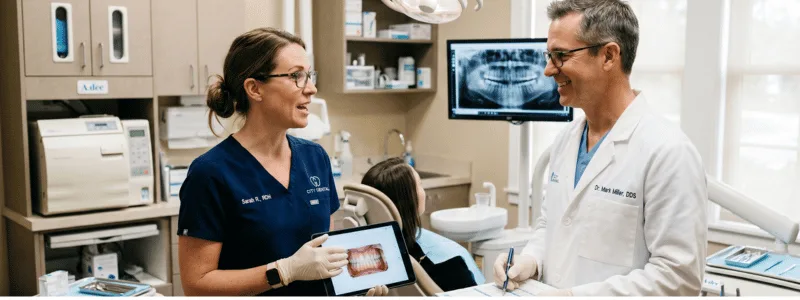
The dental hygienist and dentist relationship is the backbone of every productive dental practice. Together, they make up the clinical core of patient care, the dentist diagnosing and treating disease, the hygienist preventing it. But the working relationship between these two roles goes deeper than a job description. It spans clinical collaboration, legal scope of practice, workflow coordination, and increasingly, a shared dependency on a flexible staffing model that can keep pace with modern dentistry.
Whether you’re a dental hygienist exploring your options, a dentist navigating coverage gaps, or an office manager trying to understand how hygiene fits into your practice model, this guide breaks down exactly how these two roles work together and how platforms like GoTu are changing the way that partnership gets built.
What Does a Dental Hygienist Do?
A dental hygienist is a licensed oral health professional whose primary focus is preventive care. Their core clinical responsibilities typically include:
Prophylaxis (teeth cleaning), scaling and root planing for patients with periodontal disease, dental radiographs (X-rays), periodontal assessments and charting, oral cancer screenings, patient education on home care and nutrition, fluoride treatments and dental sealants, and in many states, local anesthesia administration.
Hygienists are not general support staff, they are licensed clinicians who generate a substantial portion of a dental practice’s revenue. A well-run hygiene schedule is often responsible for 30 to 40 percent of a practice’s total production, making the hygienist’s role central to both clinical quality and business health.
What Is the Dentist’s Role in the Dental Hygienist Relationship?
The dentist serves as the supervising clinical authority in a dental practice, responsible for diagnosis, treatment planning, and any procedures that go beyond the hygienist’s legally defined scope. Their role in the hygienist relationship includes:
Conducting comprehensive and periodic exams, reviewing hygiene notes and radiographs, co-diagnosing conditions identified during hygiene appointments, prescribing treatments such as periodontal therapy or restorative work, and providing clinical oversight as required by state law.
The quality of the relationship between a hygienist and dentist directly shapes patient outcomes. When the two communicate well like sharing notes, flagging concerns, and aligning on protocol, patients receive more consistent, proactive care. When that communication breaks down, care quality suffers and scheduling inefficiencies compound.
Scope of Practice: How It Varies by State
One of the most important and often misunderstood aspects of the dental hygienist and dentist relationship is that it is legally defined, and those definitions vary significantly from state to state. Scope of practice determines what a hygienist is permitted to do, what requires a dentist’s direct involvement, and how much independence a hygienist may exercise.
Supervision levels are the clearest expression of this variation. Most states use one of three models:
- Direct supervision requires the dentist to be physically present in the office and to authorize the procedure before the hygienist performs it. This is the most restrictive model and is still required for certain procedures in most states, even those with otherwise expanded hygiene scopes.
- General supervision allows a hygienist to perform authorized procedures without the dentist being physically present in the office, though the procedures must still fall within a standing order or treatment plan. This is common for routine cleanings and preventive services in most states.
- Unsupervised or independent practice allows a licensed hygienist to provide services without any dentist supervision. This model is available in a smaller number of states and is most often associated with community health settings, schools, or underserved area access programs.
Expanded function designations add another layer. States including California, Colorado, Oregon, and Washington allow qualified hygienists to pursue additional credentials, sometimes called Registered Dental Hygienist in Alternative Practice (RDHAP) in California or Expanded Practice Dental Hygienist (EPDH) in Oregon, that permit them to work in expanded settings or perform additional procedures.
Local anesthesia is among the most common expanded functions debated across state lines. As of 2024, the majority of U.S. states permit dental hygienists to administer local anesthesia with appropriate training and state authorization. A smaller number still prohibit it or require additional oversight.
Nitrous oxide administration follows a similar pattern, with many states permitting it for hygienists under general supervision.
The practical takeaway for offices: when you bring a temp or per diem hygienist in through a staffing platform, the hygienist’s licensure state and active authorizations matter. A hygienist licensed in Texas has a different legal scope than one licensed in California, even if their clinical skills are identical.
How the Working Relationship Functions Day-to-Day
In a functioning dental practice, a hygienist’s day typically runs parallel to the dentist’s schedule but intersects at key moments. The hygienist manages their own patient flow, seeing four to eight patients during a standard shift , while the dentist rotates in to conduct exams and review findings.
This parallel workflow requires coordination on several levels: scheduling (hygiene recall appointments must align with dentist exam availability), clinical handoff (hygienists document findings that dentists review before or during the exam), and protocol alignment (both clinicians need to agree on how to handle common clinical scenarios, from perio staging to fluoride recommendations).
When a hygienist is new to a practice, whether as a permanent hire or a per diem fill, this alignment doesn’t exist yet. Workflow preferences, charting systems, instrument setups, and clinical protocols all have to be established. This is one of the most common friction points practices report when using traditional staffing agencies: hygienists show up technically qualified but operationally mismatched.
How GoTu Matches Dental Hygienists to the Right Offices
GoTu is built around the reality that the dental hygienist and dentist relationship doesn’t function well on credentials alone. The platform matches hygienists to offices based on a combination of verified credentials, clinical capabilities, and the workflow preferences that determine whether a shift actually runs smoothly.
When a dental hygienist creates a GoTu profile, they specify their active licensure and state, any expanded functions or additional certifications, the software systems they know (Dentrix, Eaglesoft, Curve, etc.), their clinical experience level and specialty exposure, and their preferred shift types, locations, and practice environments.
When a dental office posts a shift, they define their specific requirements: the software they use, the clinical mix of the day, the supervision model in place, and any notes about practice style or patient population. Professionals see this information when applying to know exactly what type of profession that offices needs. The result is that when a GoTu hygienist walks into a practice, the dentist isn’t spending the first hour of the shift troubleshooting mismatched expectations.
For offices, this matters because an unfilled hygiene day costs the average dental practice roughly $1,200 in lost production, and a poorly matched fill can cost almost as much in disrupted workflows and rescheduled patients. For hygienists, it matters because showing up to a shift that doesn’t match your clinical strengths or preferences isn’t flexible work, it’s just unpredictable stress.
The Shift Toward Per Diem and Flexible Hygiene Staffing
The relationship between dental hygienists and dental offices has evolved over the past decade. Full-time employment is no longer the only path, and for many hygienists, it is no longer the preferred one. Per diem and part-time hygiene work has grown substantially, driven by hygienists seeking flexibility, offices managing fluctuating schedules, and a broader dental workforce shortage that has made traditional hiring pipelines unreliable.
GoTu exists because that shift happened and the infrastructure to support it didn’t. Hygienists needed a way to find quality temporary shifts without randomly calling offices. Offices needed a way to find qualified hygienists without agency markups, long lead times, or blind placements.
As of today, GoTu is the largest dental staffing marketplace in the U.S., with hygienists and offices across all 50 states. The platform is designed not just to fill shifts but to build the kind of functional working relationship, between hygienist and office, and by extension, between hygienist and dentist, that makes dental care work.