



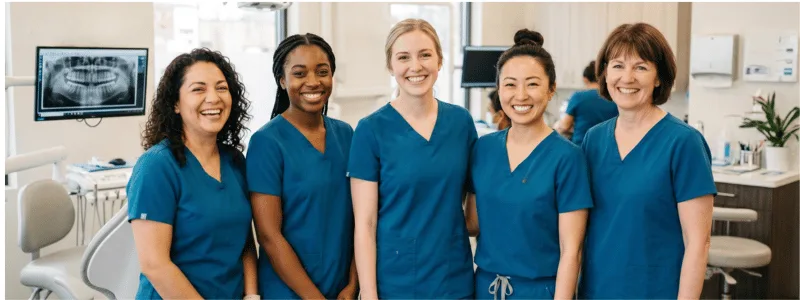
The version of dental hygiene that most people picture, one office, one schedule, same chair for decades, is still out there. But it is no longer the only version, and for a growing number of hygienists, it is not the preferred one.
The profession has changed. Patient demand is up, practice staffing is down, and hygienists have more leverage than they have had in a generation. The question is whether you are using it. This guide breaks down what the dental hygienist career path actually looks like in todays world, where it can go, and how per-diem and multi-office work have opened options that did not meaningfully exist five years ago.
The Basics: What a Dental Hygienist Does
Dental hygienists are licensed oral health professionals who work directly with patients to prevent and treat oral disease. The core clinical work includes scaling and root planing, periodontal charting, radiography, fluoride application, and patient education. In most states, hygienists also screen for oral cancer and systemic conditions with oral manifestations.
The scope of what a hygienist can do varies by state. Local anesthesia administration, laser therapy, and expanded function duties like placing sealants or taking impressions are all within hygienist scope in some states and not others. Knowing your state’s practice act is part of managing your own career.
The Bureau of Labor Statistics reported a median annual wage of $94,260 for dental hygienists, with the top 10 percent earning more than $120,000. Employment is projected to grow 7 percent from 2024 to 2034, more than double the average rate for all occupations. About 15,300 openings are expected each year for the next decade.
That is the floor. What you build on top of it depends on how you structure your career.
How Hygienists Have Traditionally Built Their Careers
For most of the profession’s history, the typical trajectory looked like this: graduate, get licensed, land a full-time position at one office, and stay. The upside was stability. Consistent patients, predictable hours, a known environment. The downside was also consistency: the same ceiling, limited negotiating power, and a compensation structure that often did not keep pace with the market.
GoTu’s 2025 State of Work Report, which surveyed 2,087 registered dental hygienists nationwide, found that 67 percent of hygienists have changed practices at some point in their careers, with better compensation and more flexibility as the primary drivers. The same report found that 63 percent of hygienists have experienced burnout at some point, and that 21 percent anticipated leaving the profession within a decade, citing physical demands, burnout, and limited growth opportunities.
That is not a workforce that is satisfied with the traditional model. And the market has started to reflect it.
How Hygienists Have Traditionally Built Their Careers
Several forces converged over the past five years to shift the balance of power in dental hygiene employment.
The workforce shortage is real. The American Dental Association’s Health Policy Institute has documented that recruiting dental hygienists has been extremely challenging for the majority of general practices in recent years. The pipeline of new graduates has not kept up with demand. Practices that once had the upper hand in hiring negotiations no longer do.
Remote work reshaped expectations across every profession. Dental hygiene is inherently hands-on, so full remote work is not an option. But the expectation of schedule flexibility, which knowledge workers gained during the pandemic, has carried into clinical healthcare fields. Hygienists are increasingly unwilling to trade their autonomy for the security of a single employer.
Per-diem staffing platforms made flexibility operationally viable at scale. Previously, picking up temp work meant calling agencies, waiting for callbacks, and dealing with paper credentialing processes. Now, platforms like GoTu let hygienists browse open shifts in their area, accept the ones that fit their schedule, and get paid without the friction of the traditional temp agency model. The infrastructure for a flexible career now exists in a way it simply did not before.
The Per-Diem Path: How It Works in Practice
Per-diem dental hygiene work means picking up shifts at dental practices on an as-needed basis, without committing to a permanent position. You choose when you work, where you work, and how much you take on.
Here is what that looks like in practice for different types of hygienists.
New graduates. After passing the NBDHE and clinical boards and receiving your state license, you are eligible to create a provider profile on GoTu and start accepting shifts. For new grads, per-diem work is one of the fastest ways to build clinical breadth. In a single month, you might work in a pediatric practice, a high-volume DSO, a fee-for-service boutique office, and a general practice with a heavy periodontal focus. That range of experience, different charting systems, different patient demographics, different clinical philosophies, develops adaptability that a single-office job cannot replicate.
Experienced hygienists seeking flexibility. Many hygienists reach a point where the traditional five-day schedule no longer fits their life. Whether it is family obligations, a health transition, pursuing a degree, or simply wanting more control over their time, per-diem work lets them maintain income and clinical sharpness without a fixed commitment. Working three days a week on GoTu while keeping one consistent office relationship, or going fully per-diem, are both viable structures.
Income supplementation. Some hygienists hold a part-time permanent position and supplement it with per-diem shifts. This approach combines the predictability of an anchor relationship with the income upside of the per-diem market. In high-demand markets, per-diem rates often run above the equivalent hourly rate for full-time positions, because practices pay a premium for same-week or same-day coverage.
Career transitions. Hygienists who are considering a move into non-clinical roles, education, public health, or corporate work often use per-diem shifts to maintain their license and clinical skills during the transition. Keeping one foot in the operatory while building credentials in a new direction is easier when you are not locked into a full-time schedule.
What Per-Diem Actually Pays
The 2024 BLS data puts the median hourly rate for dental hygienists at approximately $45.32. Per-diem rates vary significantly by market and urgency, but in active markets, they are competitive with or above full-time equivalent rates.
In high-demand areas like California, Alaska, Washington, and Oregon, hygienists on staffing platforms regularly earn $50 to $65 per hour or more on temp shifts. Last-minute shifts in major metros often carry premium rates above the standard posted rate.
The trade-off is predictability. Per-diem work does not come with employer-sponsored health insurance or paid time off. Those benefits have real dollar value, and any hygienist evaluating a shift from full-time to per-diem should factor them into the comparison. What per-diem work does provide is rate transparency, schedule control, and the ability to turn down shifts without consequence.
Multi-Office Career Structures
Beyond fully per-diem work, many hygienists build careers that span two or three offices without committing to any single one as a primary employer. This structure is more common than it was a decade ago, and the technology to support it has improved substantially.
A hygienist might work two regular days per week at one office, one or two days at another, and fill remaining days with GoTu shifts when the income or schedule warrants. This kind of arrangement gives practices the coverage they need while giving the hygienist a diversified income base and more negotiating leverage than any single-office relationship provides.
The practical requirements for multi-office work are manageable. You need to stay current on licensure and any state-specific CE requirements, carry appropriate malpractice coverage, and be comfortable adapting quickly to different office workflows and software systems. The adaptability curve is steeper at first and becomes significantly easier with experience across multiple environments.
Career Paths Beyond Clinical Work
The operatory is where most hygiene careers start. It does not have to be where they end.
Hygienists with bachelor’s or master’s degrees in dental hygiene, or with targeted certifications, move into several adjacent career tracks.
Dental hygiene education. Instructors and program directors at community colleges, dental hygiene programs, and vocational schools draw directly on clinical experience. This path typically requires a bachelor’s degree at minimum and a master’s degree for program director or dean roles. The schedule tends to be more predictable and the burnout profile is different from clinical work.
Public health. Local and state dental public health officers, community health educators, and school-based oral health program coordinators all have backgrounds in dental hygiene. Public health roles vary widely in compensation but offer mission-driven work and often more schedule stability than clinical positions.
Corporate roles. Dental supply companies, device manufacturers, toothpaste brands, and dental software companies all hire hygienists for sales, product education, training, and clinical consulting. These roles leverage clinical credibility in a non-clinical context. Travel is often involved, but the ceiling on compensation is different from anything in the operatory.
Research. Hygienists with advanced degrees contribute to clinical research, outcomes studies, and policy research at universities, hospitals, and organizations like the ADA Health Policy Institute. This path typically requires at minimum a master’s degree and often a doctorate.
Practice management and consulting. Experienced hygienists move into roles as practice managers, hygiene coordinators, and consultants who work with practices to improve production, patient retention, and care quality. This path is increasingly accessible to hygienists who have worked across multiple environments and understand what differentiates a high-performing hygiene department from an average one.
The Career Is What You Build It To Be
Dental hygiene is not a static job. The technical skills required, the scope of practice available, the employment structures that exist, and the markets that pay for your work have all evolved significantly. The hygienists who are most satisfied with their careers are the ones who treat it as a set of options to be actively managed rather than a track to follow.
Per-diem and multi-office paths are not for everyone. Some hygienists genuinely prefer the consistency of a long-term single-office relationship, and that preference is valid. But the option to structure your career differently now exists in a real and practical way, backed by technology and marketplace demand that make it viable.
The profession has more leverage to offer its practitioners than it has in a long time. The question is how you use it.
Ready to explore what per-diem hygiene looks like in your market? Create your free dental hygienist profile and see what is available near you.