


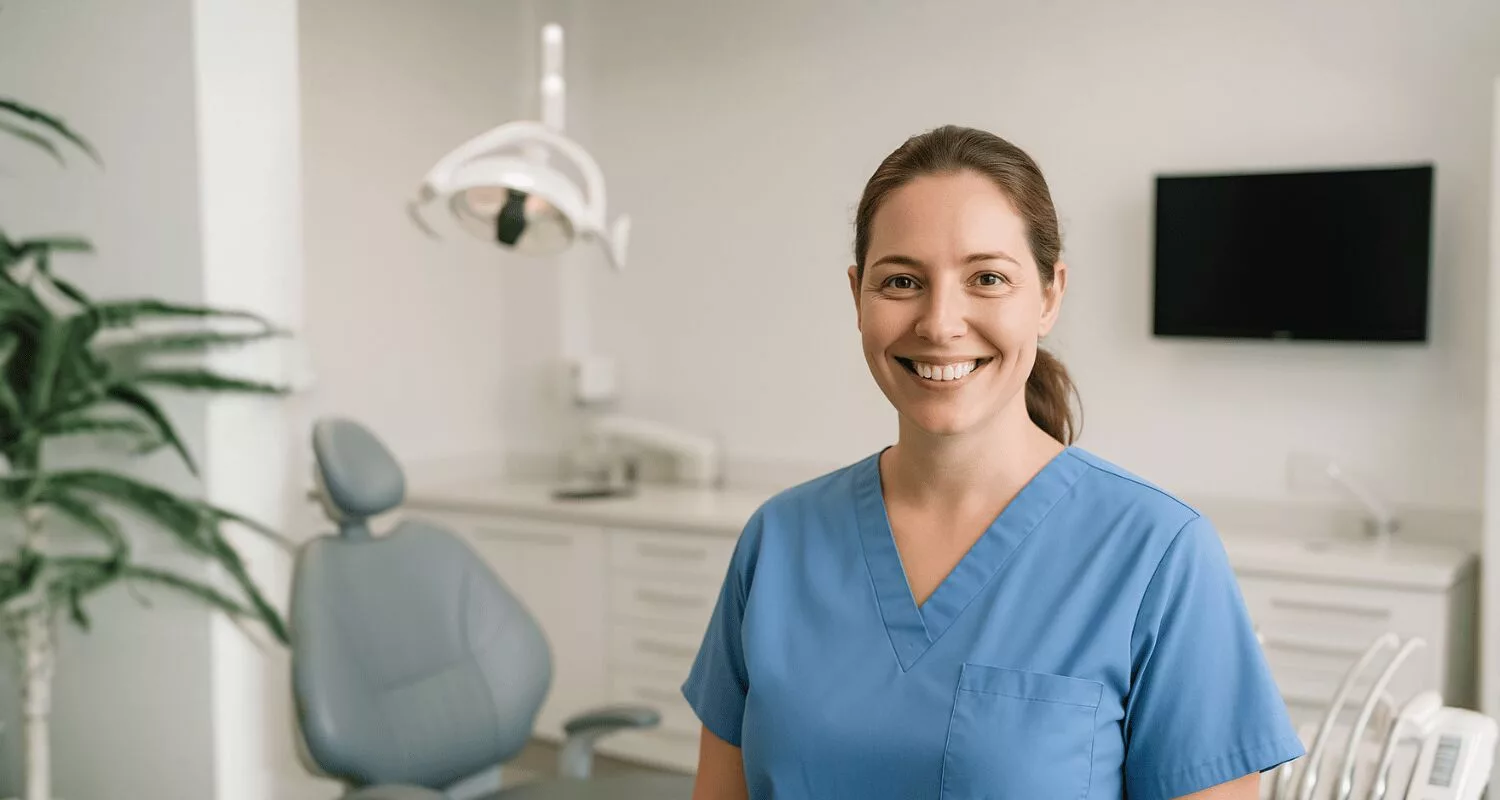
Washington Dental Assistant Responsibilities and Scope of Practice
What Washington dental assistants can and can't do, and the supervision rules behind it.
- 12Duties listed in this guide
- 7Limits listed in this guide
- YesCoronal polishing allowed
Sources: Washington Dental Quality Assurance Commission; RCW 18.260.020 to 18.260.070; WAC 246-817-510, 246-817-520, 246-817-525, 246-817-540, 246-817-545. Last updated: November 2026
Dental assistants in Washington support the dentist chairside, prepare patients and instruments, and perform the clinical tasks the rules allow (RCW 18.260.020 to 18.260.070; WAC 246-817-510, 246-817-520, 246-817-525, 246-817-540, 246-817-545). This guide covers what assistants can do at each level, the supervision they need, and what stays with the dentist or hygienist.
This guide is part of our Washington dental assistants hub. Related Washington guides: salary, requirements, and associations. For other states, see all dental assistant guides.
What can a dental assistant do in Washington?
Under RCW 18.260.020 to 18.260.070; WAC 246-817-510, 246-817-520, 246-817-525, 246-817-540, 246-817-545, Washington dental assistants can perform supportive and clinical tasks such as those listed below. The Washington Dental Quality Assurance Commission sets the rules, and the supervising dentist decides which tasks to delegate based on each assistant’s training.
- Oral inspection with no diagnosis, blood pressure, and vital signs.
- Placing, exposing, and processing radiographs.
- Coronal polish and fluoride treatments.
- Assisting with nitrous oxide, including starting and stopping the flow as directed.
- Placing topical anesthetics and rubber dams.
- Applying sealants.
- Placing cavity liners and bases, acid etch, and bonding agents.
- Taking impressions and digital scans for models, orthodontic appliances, and temporaries.
- Fabricating, cementing, and removing temporary crowns and bridges.
What expanded duties can Washington dental assistants perform?
Assistants who hold the Washington Expanded Function Dental Auxiliary (EFDA) or related certifications can take on more clinical work. EFDA license: approved assisting and EFDA programs plus written and clinical restorative exams. These duties still need a dentist’s supervision. Check the rule for the exact conditions before you take them on.
- Placing, carving, finishing, and polishing direct restorations.
- Final impressions and bite registrations, including CAD/CAM.
- Coronal polishing, fluoride, sealants, and radiographs under general supervision.
Can Washington dental assistants polish teeth and place sealants?
Coronal polishing: registered assistants may coronal polish under close supervision, and the dentist must confirm the teeth are free of calculus before dismissal (WAC 246-817-520). Sealants: registered assistants may apply sealants under close supervision; EFDAs under general supervision (WAC 246-817-520 and 525).
What supervision do Washington dental assistants need?
Registered dental assistants in Washington work under close supervision, which means the dentist has personally diagnosed the condition and authorized the procedure and is continuously on site, though not necessarily in the operatory (RCW 18.260.010; WAC 246-817-510). EFDAs may do some preventive tasks under general supervision.
What can’t a dental assistant do in Washington?
Washington rules keep some procedures with licensed dentists and hygienists. The list below covers the main limits we found in the state law and rules, with the citation for each in the sources. If a task is not on the allowed list for your level, check with the board before you perform it.
- Removing or adding to hard or soft tissue (WAC 246-817-540).
- Placing permanent restorations, for registered assistants.
- Diagnosis or prescribing treatment.
- Administering general or local anesthetic.
- Oral prophylaxis other than coronal polishing, and any scaling.
- Cementing permanent restorations or stainless steel crowns.
- Suturing or incising soft tissue.
Comparing states? See expanded function dental assistants by state and radiography requirements by state.
Frequently asked questions
Close supervision, dentist on site; EFDAs have some general supervision duties. Registered dental assistants in Washington work under close supervision, which means the dentist has personally diagnosed the condition and authorized the procedure and is continuously on site, though not necessarily in the operatory (RCW 18.260.010; WAC 246-817-510).
Allowed for registered assistants under close supervision; no separate x-ray certificate.
Registered assistants may coronal polish under close supervision, and the dentist must confirm the teeth are free of calculus before dismissal (WAC 246-817-520).
Registered assistants may apply sealants under close supervision; EFDAs under general supervision (WAC 246-817-520 and 525).
Off limits under Washington rules: removing or adding to hard or soft tissue (WAC 246-817-540); placing permanent restorations, for registered assistants; diagnosis or prescribing treatment.
The Washington Dental Quality Assurance Commission enforces the rules, which come from RCW 18.260 and WAC 246-817.
Sources
- RCW 18.260, Dental Assistants and Expanded Function Dental Auxiliaries. https://app.leg.wa.gov/RCW/default.aspx?cite=18.260&full=true
- WAC 246-817-510, Definitions. https://app.leg.wa.gov/WAC/default.aspx?cite=246-817-510
- WAC 246-817-520, Supportive services by registered dental assistants. https://app.leg.wa.gov/WAC/default.aspx?cite=246-817-520
- WAC 246-817-525, Supportive services by licensed EFDAs. https://app.leg.wa.gov/WAC/default.aspx?cite=246-817-525
- WAC 246-817-540, Acts that may not be performed by registered dental assistants. https://app.leg.wa.gov/WAC/default.aspx?cite=246-817-540
Download the GoTu app
Browse dental assisting shifts and manage your schedule in the app.